
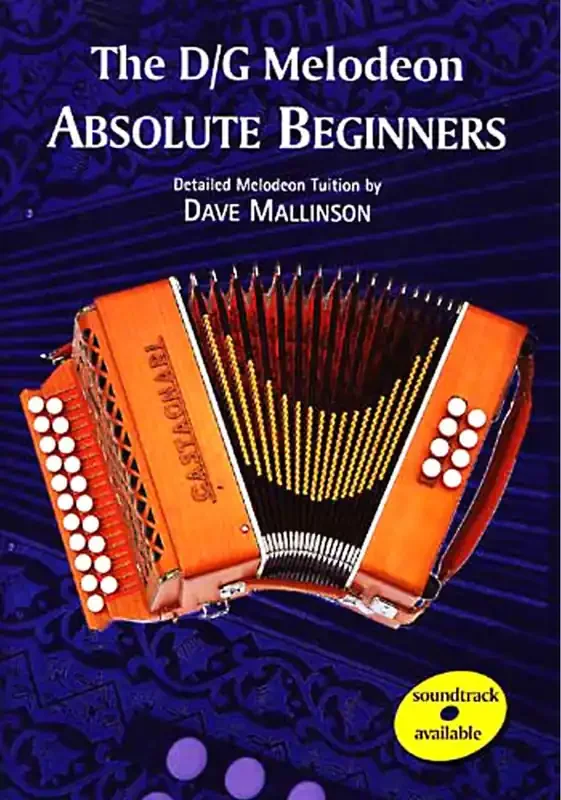
Description
Description
The aim of this book is to get students off to the best possible start on the D/G melodeon, by presenting information that might otherwise take years to accumulate.
There are many styles of traditional music where the melodeon and its siblings play a major role. Irish, English, French, Tex-Mex, French Canadian, Cajun, Morris and Zydeco are all typical examples. This is not intended to be a specialist book but it endeavours to give students a good grounding, helping them to easily move on to whatever music genre takes their fancy. However, the lessons within are completely based on traditional playing styles and tunes from Britain and Ireland.
In all walks of life, whether it be mathematics, designing aeroplanes or playing the violin, mankind progresses by first being taught what previous generations have learned, before moving on. Unfortunately, in the case of the melodeon, this doesn‰۪t seem to happen; melodeon students all seem to have to start at rock bottom and work things out for themselves. Although things are improving considerably there is still a long way to go; hopefully, this book will make a useful and effective contribution to rectifying this situation.åÊ
If you want to become proficient on any musical instrument, you must practise. There is no way round this. You can have the best tuition in the world, but without practice it is useless. Unfortunately, without guidance, it is very easy for students to find themselves practising unsound techniques and falling into bad habits and sloppy playing. It is the intention of this book to steer players into acquiring efficient techniques and to help them develop good habits, from day one. It isåÊassumed that readers of this tutor have no previous knowledge of the melodeon or music: all topics start with absolute basics.
There are many different ways of playing the melodeon. Even sticking rigidly to the methods advocated in this book gives plenty of scope for choice. It is not the intention of this book to lay down hard and fast rules, but to provide information for you to make up your own mind: there are always several ways of playing a tune correctly.
Contents
Foreword by Andy Cutting
Introduction
The Squeezebox Family
Music Basics for Squeezers
Introducing the D/G Melodeon
Holding the Melodeon
The Air Button
The High Octave
The Treble Buttons
Counting Time
Major Keys
Minor Keys
Shifting Hand Position
Introducing the Bass Buttons
Playing the Bass in Time
Various Rhythms
Crossing the Rows
The Basses
Playing the Other Bass Buttons
Um Cha Through Some Easy Tunes
Smoothing the Bellows Action
The Other Chord in the key of D
Fundamentals and Chords
Playing the Bass in Harmony
Percussive Bass : No Bass
Drones and Snappy Off-Beats
Accidentals
A minor and B minor
Slides and Slip Jigs
The Key of A
The Variable Buttons
TransposingåÊ
åÊ
Tunes
åÊ
Hot Cross Buns!
Baa Baa Black Sheep
Jingle Bells
Little Brown Jug
Mulberry Bush
Oranges and Lemons
Bobby Shaftoe
Three Blind Mice
Whip Jamboree
Drunken Sailor
Silent Night
The Best of Society
Fr̬re Jacques
Egan‰۪s Polka
What Can the Matter Be?
Cock of the North
Katie Bairdie
The Keel Row
Polly Put the Kettle On
Skip to My Lou
Shepherds‰۪ Hey
Tralee Gaol
I Have a Bonnet
Donkey Riding
Buffalo Girls
Uncle Bernard‰۪s Polka
Rakes of Mallow
Davy Davy Knick Knack
Twinkle Twinkle Little Star
Bonny Green Garters
Rodney
Liza Jane
Constant Billy
The Twenty-Ninth of May
Sweet Jenny Jones
My Darling Asleep
The Steamboat
Sonny‰۪s Mazurka
Speed the Plough
Soldiers‰۪ Joy
Staten Island
A Trip to the Cottage
The Tenpenny Bit
Tripping Upstairs
The Scattery Island Slide
Drops of Brandy
Bill Sullivan’s Polka
Sweeney‰۪s Polka


Reviews
There are no reviews yet.